Reading Time:
5 min
Generic corporate videos are failing. The defining trend of 2026 is hyper-personalization. Learn how modular storytelling and audience-specific content are replacing the "one-size-fits-all" approach to drive real engagement.


Generic corporate videos are failing. The defining trend of 2026 is hyper-personalization. Learn how modular storytelling and audience-specific content are replacing the "one-size-fits-all" approach to drive real engagement.
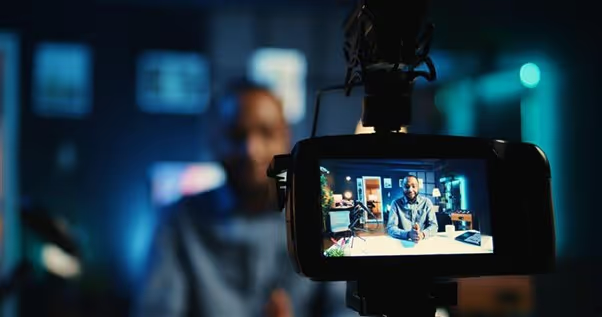
By 2025, many organizations faced an uncomfortable reality: their corporate videos were no longer delivering results. Despite professional visuals and carefully scripted messaging, engagement rates continued to fall. Internal audiences skimmed or skipped videos entirely, while external viewers abandoned them within seconds. The issue was not production quality, nor was it declining interest in video as a medium. The problem was relevance.
Corporate videos had become generic at precisely the moment audiences began expecting content tailored to their specific needs, roles, and priorities. Digital platforms conditioned viewers to expect personalization in nearly every interaction, from news feeds to product recommendations. Against this backdrop, a single, linear corporate video designed to speak to everyone increasingly felt like it spoke to no one. This disconnect defines the central pain point driving Video Production Trends 2026: audiences no longer tolerate one-size-fits-all storytelling.
The shift toward hyper-personalization is not a creative preference; it is a data-supported response to changing audience behavior. Research from McKinsey shows that personalization can drive revenue increases of 10 to 15 percent while improving customer satisfaction and engagement. While this research is often discussed in marketing contexts, the underlying principle applies directly to corporate communication: people engage more deeply when content reflects their specific context.
Video consumption data reinforces this point. Cisco’s Visual Networking Index confirms that video remains the dominant form of internet traffic globally, but it also highlights increasing competition for attention within that space. Viewers are exposed to more video than ever before, making relevance the deciding factor in whether content is watched or ignored. Supporting this, Wistia’s video analytics research demonstrates that segmented and audience-specific videos consistently outperform generalized videos in watch time and completion rates.
Hyper-personalization addresses this challenge by allowing corporate video to adapt its message without diluting brand identity. Instead of producing entirely separate videos for each audience, organizations increasingly rely on modular storytelling. Core narratives remain consistent, while messaging, examples, and emphasis change based on viewer role, industry, or stage in the decision process. In 2026, this approach is no longer experimental; it is becoming a baseline expectation for effective corporate video strategy.
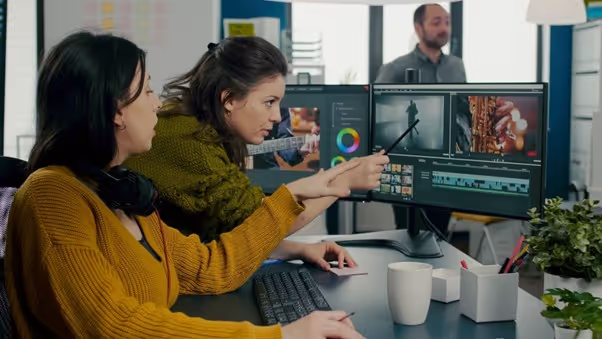
Implementing hyper-personalization requires a shift in how corporate videos are planned and produced. The process begins with audience clarity. Before a script is written or a camera is set up, the intended viewers must be clearly defined. This includes not only demographic information, but functional needs, knowledge level, and the specific problem the video is meant to address.
Once the audience is defined, modular narrative design becomes essential. Rather than writing a single linear script, the story is structured in interchangeable segments. An opening sequence establishes brand identity and tone, followed by sections that can be swapped or reordered depending on who is watching. This structure allows one production to serve multiple purposes without feeling repetitive or generic.
Interactive elements increasingly support this approach. Branching narratives, where viewers select topics or paths relevant to them, are becoming a practical solution rather than a novelty. Deloitte’s digital engagement research indicates that interactive content increases time spent and perceived value, particularly in professional and B2B settings. When viewers actively choose what they watch next, they are more likely to remain engaged and retain information.
Finally, hyper-personalization must be supported by consistent visual and narrative language. While messages adapt, brand identity must remain recognizable. This balance between flexibility and consistency is central to successful Video Production Trends 2026 and requires close collaboration between creative, strategic, and production teams.

While strategy drives effectiveness, technical execution still shapes perception. In 2026, 4K acquisition has become the standard for corporate video production, even when final delivery occurs at lower resolutions. Shooting in higher resolution provides flexibility in post-production, particularly when creating multiple versions or adapting content for different platforms.
Visual style should be intentional rather than trend-driven. Cinematic lighting and controlled composition are increasingly used to establish credibility and emotional resonance, especially in brand-led content. At the same time, personalized segments often benefit from clarity and direct framing, ensuring information is easy to process. Research from BBC audience studies shows that consistent visual language reduces cognitive load while improving recognition, reinforcing the importance of stylistic coherence across modular content.
Sound design is equally critical. As corporate videos are consumed across offices, mobile devices, and headphones, clear dialogue and controlled ambient sound strongly influence viewer trust. Poor audio quality remains one of the fastest ways to undermine perceived professionalism, regardless of how strong the visuals may be.
The defining Video Production Trends 2026 reflect a broader shift in how organizations communicate. Generic corporate video declined not because video lost relevance, but because audiences demanded more precision, relevance, and respect for their time. Hyper-personalization, supported by modular storytelling and thoughtful production design, has emerged as the most effective response to this shift.
For organizations navigating this evolution, success depends on more than technology. It requires strategic clarity, narrative discipline, and production expertise capable of balancing cinematic quality with audience-specific relevance. All in Motion works with brands to design and produce corporate videos that meet these demands, creating content that is not only visually compelling but genuinely effective.
To explore how hyper-personalized video can strengthen your corporate communication strategy in 2026 and beyond, visit www.allinmotion.com and start the conversation.
We craft videos and visuals that connect, inspire, and resonate.
Let’s create something worth watching — and remembering.
hello@allinmotion.com