Reading Time:
8 min
Hybrid video production blends live action with 3D environments to create scalable, high-impact corporate videos for modern B2B brands.


Hybrid video production blends live action with 3D environments to create scalable, high-impact corporate videos for modern B2B brands.

There is a moment in every ambitious B2B video brief where the creative vision outpaces the production budget. The client wants to show their product deployed inside a hyperscale data center. Or demonstrate a manufacturing process that cannot be filmed safely. Or place a human presenter inside a branded environment that does not exist anywhere in the physical world.
For most of the history of corporate video, the answer to these briefs was either to compromise the creative vision or to absorb costs that made the project financially unviable. That has fundamentally changed.
The convergence of real-time 3D rendering engines, LED volume technology, and accessible CGI pipelines has created a new production paradigm: hybrid video production. This approach blends live-action footage of real people and objects with 3D-rendered environments, products, and assets, producing results that were once exclusive to feature film budgets. For B2B brands, it represents one of the most significant expansions of creative possibility in a generation.
This piece unpacks what hybrid production actually involves, where it outperforms traditional approaches, and why the economics make it increasingly compelling for enterprise content.
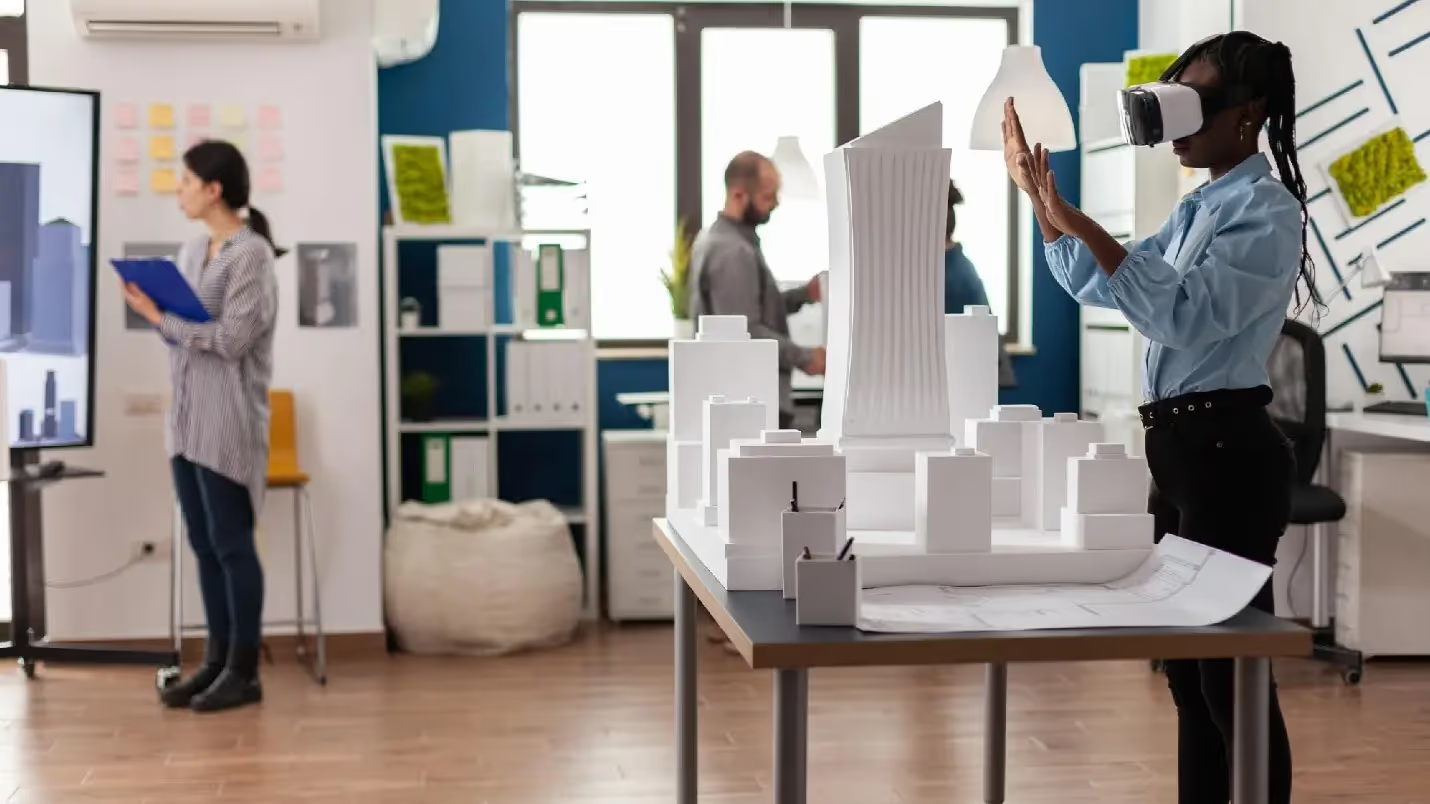
The first decision in any hybrid production is where the live-action elements will be captured. There are two primary approaches: shooting against a physical set or location that will be composited with 3D elements in post, or shooting against a real-time LED volume where the 3D environment is rendered live on screen behind the talent.
The legacy approach to hybrid production involves shooting talent or product against a green screen, then compositing the footage into a 3D environment in post-production. This method is well understood, widely available, and cost-effective for straightforward composites.
Its limitations are also well documented. Reflective surfaces, hair, and transparent materials composite poorly. Lighting must be matched precisely between the live-action and 3D elements in post, which is technically demanding. And talent performing against an empty green void often struggle to deliver grounded, naturalistic performances without visual context.
LED volume production uses large curved or flat LED walls displaying real-time rendered 3D environments. The technology, made famous by The Mandalorian's Volume stage, has rapidly become accessible to commercial production at enterprise scale. The practical advantages for B2B hybrid video production are significant:
● In-camera compositing: the 3D environment renders live behind the talent, visible both on camera and to the talent themselves, enabling natural performances and real-time creative decisions.
● Practical lighting: the LED walls emit real light into the set, meaning the talent is genuinely lit by their virtual environment. Reflections on surfaces, catch-lights in eyes, and color spill all happen naturally.
● Immediate client feedback: since the composite is visible on set in real time, clients can approve the look before the camera rolls rather than waiting for post-production.
● Reduced post-production cost: what would require extensive rotoscoping and compositing work in a green screen workflow can be captured in-camera, compressing the post schedule significantly.
The third approach, shooting on real physical locations and integrating 3D elements in post, is often the most effective for product-focused B2B content. A presenter filmed in a real office environment gains a groundedness and authenticity that LED volumes cannot fully replicate, while 3D-rendered product close-ups, data visualizations, or environment extensions add the production value that a physical location cannot provide alone.
This hybrid of real and rendered is the dominant approach in enterprise technology marketing, where the product often cannot be filmed directly (it is software, a service, or a physical object too large or complex to bring to a studio) but human credibility is essential to the narrative.

One of the most common and most technically demanding requirements in B2B hybrid production is the product integration shot: a human hand interacting with a 3D-rendered product. This might be a hand holding a device that does not yet physically exist, a presenter gesturing toward a virtual interface, or an engineer appearing to handle a component that is rendered in CGI.
Done badly, these shots are immediately unconvincing. The lighting does not match. The shadows are wrong. The interaction feels like the person is miming at empty space. Done well, they are indistinguishable from reality.
The quality of a hand-and-product integration shot depends almost entirely on the quality of the data captured during the live-action shoot:
● HDRI environment capture: a 360-degree HDR image of the shooting environment, captured at the position and moment of the shot, gives the 3D rendering team the exact lighting information needed to match the CGI product to the live footage.
● Tracking markers: small, clearly visible markers placed in the shooting environment allow the compositing team to precisely match the camera's movement in 3D space, enabling the rendered product to behave correctly as the camera moves.
● Reference footage: filming a physical stand-in object of the correct size and weight gives the 3D artist accurate reference for how the product would actually move in the hands of the performer.
● Clean plates: filming the same shot without the performer or stand-in gives compositors the background they need to make the integration seamless.
The investment in this data capture during the shoot pays for itself many times over in reduced compositing time and a more convincing final result. Teams that skip these steps consistently spend more time in post trying to solve problems that should have been addressed on the day.
The most common misconception about hybrid video production is that it is more expensive than traditional production. For straightforward content, this can be true: adding a 3D pipeline to a live-action shoot introduces CGI rendering, compositing, and additional post-production time. But for the categories of content where hybrid production is most relevant, the cost comparison almost always favors the hybrid approach.
Consider the alternatives for a brand that wants to show its enterprise software product deployed in a large-format, visually impressive server environment:
● Option A (traditional): arrange access to a real data center, navigate security and filming restrictions, bring a full crew and talent to the location, manage lighting in a technically complex physical environment. Cost: high, timeline: unpredictable.
● Option B (fully animated): produce the entire environment in 3D CGI without any live-action element. Cost: moderate to high depending on complexity, but lacking the human credibility of a real presenter.
● Option C (hybrid): film a presenter in studio against green screen or LED volume, produce the data center environment in 3D, composite. Cost: typically 30 to 50% less than Option A for comparable production values, with full creative control and no location access dependencies.
The economic case for hybrid production becomes even stronger when you factor in asset reusability. A 3D-rendered data center environment, once built, can be used in multiple videos with different lighting conditions, camera angles, and time-of-day variations. A 3D product model built for a launch film can be repurposed for a product tour, a sales enablement video, a conference keynote, and social media cutdowns, without additional build cost.
Physical shoots do not offer this. Every visit to a physical location incurs the full cost of crew, logistics, and talent. The 3D asset, once built, has a marginal cost of near zero for subsequent uses. For enterprise brands running multi-video content programs, the case for investing in a 3D asset library early is compelling.
● Invest in pre-production planning: the cost of hybrid errors is compounded in post. Detailed 3D previsualisation (previZ) before the shoot allows the team to solve integration problems before camera rolls.
● Build to camera: 3D models only need to be render-quality in the areas the camera will see. Full-resolution modelling of unseen surfaces wastes rendering budget.
● Standardize your 3D pipeline: consistent software choices (Unreal Engine for real-time, Cinema 4D or Houdini for high-complexity renders) across projects build internal expertise and reduce per-project setup costs.
● Brief your live-action director and your CGI lead simultaneously: the two disciplines need to make creative decisions together from the start of pre-production, not hand off to each other sequentially.
Hybrid video production has crossed the threshold from niche capability to production standard. For B2B brands operating at enterprise scale, the question is no longer whether to use hybrid production, but how to build it into the standard production toolkit in a way that is economically sustainable and creatively consistent.
The brands building competitive advantages in content right now are treating 3D asset libraries as long-term investments, building hybrid production into their content calendars rather than treating it as a one-off capability, and working with production partners who understand both the live-action and CGI disciplines well enough to brief each other correctly.
The Unreal Engine revolution is not coming for enterprise content. It is already here. The question is whether your production approach is built to take advantage of it.
We craft videos and visuals that connect, inspire, and resonate.
Let’s create something worth watching — and remembering.