Managing creative at global scale is not a production challenge. It is a strategic one. Here is how enterprise marketing teams get it right.


From Our Blog
—
From Our Blog
—
From Our Blog
—
From Our Blog
—
From Our Blog
—
From Our Blog
—
Global Creative Production: How Enterprise Teams Maintain Brand Standards Across Time Zones and Agencies

Share:

Picture a global enterprise brand running campaigns across North America, Europe, and Asia Pacific simultaneously. Each region has its own marketing team, its own agency relationships, and its own interpretation of the brand guidelines. The result is predictable: assets that look subtly different across markets, messaging that drifts from the core positioning, and a brand that feels inconsistent to the very buyers it is trying to impress.
This is not a hypothetical. It is the operational reality for most enterprise brands managing global creative production. And it is one of the hardest challenges in international marketing ops, not because the individual pieces are complicated, but because the coordination required to keep them aligned at scale demands infrastructure that most organisations do not have in place.
The brands that get it right share a common approach: they treat global brand production not as a logistics problem to manage, but as a strategic capability to build. This article sets out the five pillars of that capability and explains how All In Motion's global delivery model is structured to provide it.
Why Global Creative Production Breaks Down
Most enterprise brands do not have a brand consistency problem in the boardroom. They have one in the field, in the assets that regional teams produce under time pressure, in the social media content that gets localised without proper oversight, in the campaign materials that a market adapts because waiting for central approval takes too long.
The breakdown follows a recognisable pattern. A global campaign launches from the centre. Brand guidelines are distributed. Regional teams are briefed. Then the pressure of local deadlines kicks in. One market adapts an asset without going through the proper review process. Another uses an older version of a template because the asset management system is hard to navigate. A third produces entirely new creative because the central template does not work in their format. Six months in, the global brand looks like several different brands depending on which market you are looking at.
The root causes are consistent across enterprise organisations:
• Brand guidelines that are comprehensive as documents but impractical as production tools
• No single source of truth for approved assets, templates, and locked brand elements
• Approval workflows that are too slow for the pace of local market activity
• Production partners in different markets operating with different standards and different interpretations of the brief
• No centralised quality assurance process that spans the full production output
• Time zone gaps that mean questions go unanswered and decisions get made without the right oversight
Solving this requires more than better brand guidelines. It requires a production model designed for global consistency; one where every team, in every market, works from the same strategic foundation and operates within the same quality framework.
Five Pillars of Enterprise Global Creative Production
1. A Single Source of Truth for Brand Standards
The foundation of any successful global brand production model is a centralised, accessible, and genuinely usable brand system. Not a 200-page PDF that lives in a shared drive and gets ignored under deadline pressure but a living system that gives every production team, in any market, immediate access to the approved guidelines, locked assets, and templates that govern the brand.
This means a properly governed brand asset management system: structured around how creative teams actually work, with approved templates for every format, locked elements that cannot be altered without a specific approval step, and version control that eliminates the risk of outdated assets reaching the market. A dedicated Brand Ops lead internally or on the agency side, is responsible for maintaining the integrity of that system as the brand evolves. Without that ownership, even the best-built system degrades over time.
2. A Hub-and-Spoke Production Model
The most effective global creative production structure separates strategic governance from local execution. A central hub, typically the global brand or marketing team, supported by a lead agency partner, owns the creative strategy, brand standards, and master assets. Regional spokes handle local adaptation, market-specific content, and in-market deployment.
This model works because it puts the right decisions in the right hands. Strategic decisions about brand positioning, visual identity, and campaign narrative are made centrally. Tactical decisions about local format requirements, market-specific messaging, and regional compliance are made locally, where the expertise sits. The failure mode is when the two are not properly connected, when regional teams operate with too much autonomy, or when the centre moves too slowly to serve local market timelines. The solution is not more central control. It is better infrastructure: faster approval workflows, cleaner briefing processes, and a production partner who can serve both the hub and the spokes without becoming a bottleneck.
3. Technology That Enables, Not Obstructs
The right technology stack is what makes global creative production manageable at scale. This means three things working in combination: a DAM system that is genuinely navigable under deadline pressure; project management tools that give every stakeholder regardless of time zone, real-time visibility of where production stands; and approval workflows fast enough to serve local market timelines without compromising brand oversight.
The technology requirements are secondary to the process requirements. A sophisticated DAM system sitting on top of a broken approval workflow will not solve a brand consistency problem. But when the process is right, the right technology makes it scalable enabling a global agency partner to operate as a genuine extension of the internal marketing team rather than an external vendor managing a queue of briefs.
4. Quality Assurance Built Into Every Stage
Enterprise-scale global production requires a quality assurance process that is systematic, not episodic. Quality gates need to be built into every stage of production, from the initial brief through to final delivery, catching brand inconsistencies, compliance issues, and production errors before they reach the market.
For clients in regulated sectors, financial services, healthcare, enterprise technology, this is not optional. Compliance has to be a production parameter built into the brief and the adaptation process from the outset, not addressed retrospectively when an asset is already in market. The distinction matters: treating compliance as an end-of-process check is what creates expensive delays, pulled assets, and brand exposure in markets with specific content standards.
5. A Production Partner With Genuine Global Reach
The final pillar is the one most enterprise marketing teams underestimate: the creative partner. There is a meaningful difference between an agency with offices in multiple countries and one with genuine production capability across time zones, the infrastructure, the workflows, and the talent to execute complex, high-volume creative programmes across markets without the client managing the coordination. The first can handle global projects. The second can absorb global complexity. For enterprise brands producing at scale, that distinction is significant.
How All In Motion's Three-Hub Model Works

All In Motion operates production hubs in India, Poland, and Canada. This is the structural foundation of a global creative production model designed to give enterprise clients something genuinely difficult to find: a single creative partner capable of serving their entire global footprint without compromising on quality, speed, or brand consistency.
Each hub brings specific capabilities. The India hub handles large-volume production, motion graphics, animation, and high-output creative manufacturing. The Poland hub brings European market expertise, design capability, and proximity to clients operating across the continent. The Canada hub provides North American coverage and the time zone bridge that makes near-continuous production possible across a full working week.
Together, the three hubs give All In Motion's enterprise clients close to 24/5 production coverage. A brief issued at the end of the London working day is in production in India within hours. A revision requested by a North American client in the afternoon is completed and ready for review the next morning. For enterprise brands managing fast-moving campaign cycles, product launches, or global events, this is not a convenience, it is a measurable advantage that directly affects speed to market.
The model extends across geographies and content types. A leading global cloud technology company, operating out of its Singapore office, works with All In Motion to produce localised social media content for the Indonesia and Singapore markets, including festive campaigns and market-specific copy that needs to be culturally relevant while remaining consistent with the brand's global standards. For global technology and professional services organisations with marketing programmes spanning multiple continents, All In Motion manages multiple concurrent projects, brand campaigns, demand generation assets, sales enablement content, executive communications, without the client carrying the operational burden of coordinating across markets.
In Practice: A Global DOOH Campaign
A campaign All In Motion executed for a leading enterprise audio technology brand illustrates what this production model looks like under real pressure.
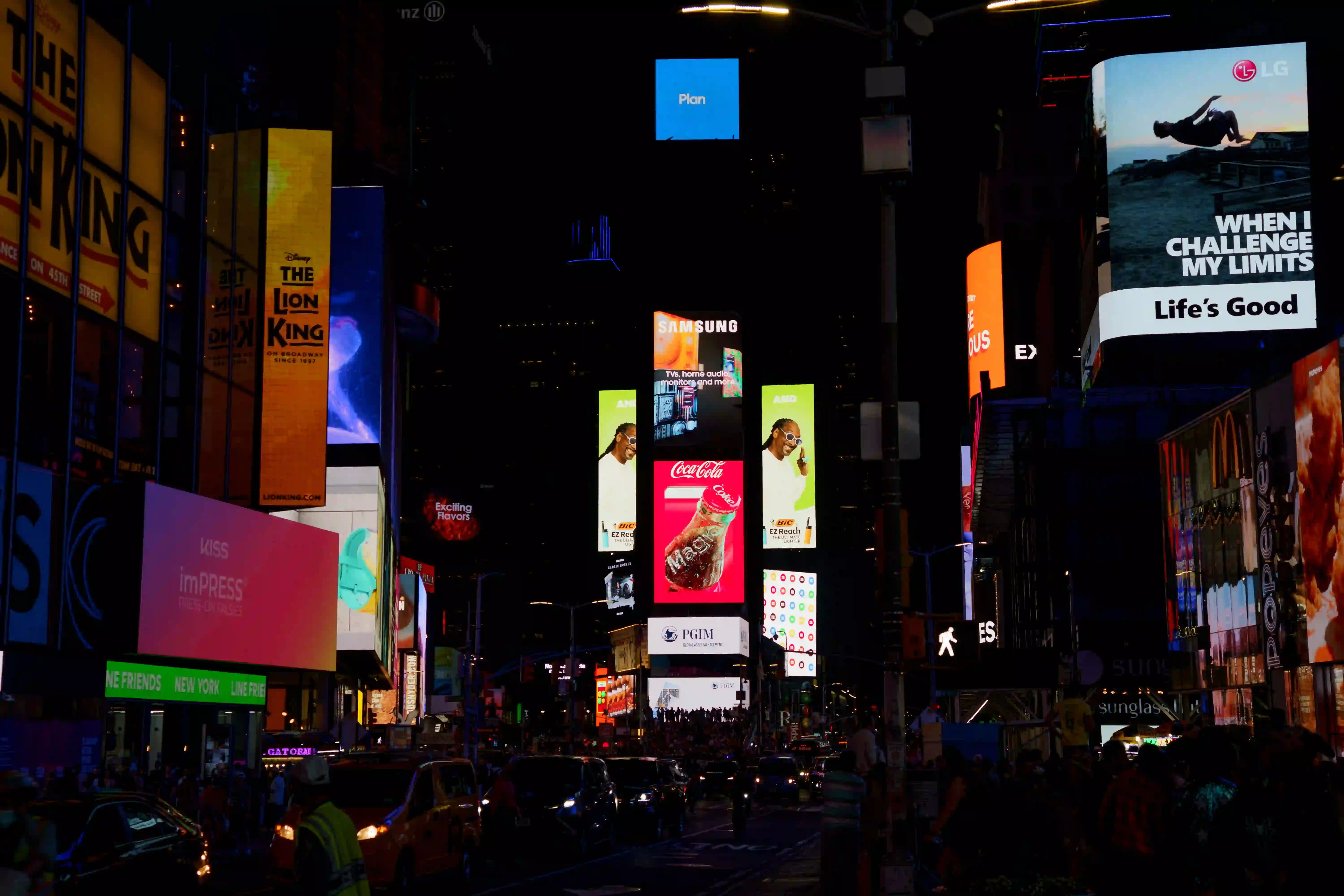
The campaign was a brand repositioning deployed simultaneously across New York, London, Chicago, and San Francisco, spanning Times Square, Canary Wharf, Bryant Park, London Bridge, and major airport networks across JFK, LaGuardia, SFO, O'Hare, and Union Station. The production challenge was executing consistently across more than fifty unique format specifications, from a 6-second Rail Digital 6-Sheet at platform level to a 60-second full-motion placement while ensuring every adaptation preserved the strategic integrity of the original creative concept.
London added a specific layer of complexity. The UK's DOOH landscape operates under ASA regulations, animated content requires flicker testing, and the Digital Gateway network spanning Canary Wharf, Bank, Waterloo, and Liverpool Street prohibits QR codes across all placements. These were not problems to solve after the creative was made. They were production parameters built into the London brief from the outset ensuring creative adaptation and compliance were a single process, not sequential ones.
The CORE™ framework governed the entire programme:
Briefing a Global Creative Production Partner: A Practical Checklist
For enterprise marketing and operations leaders briefing a global creative production partner, the quality of the brief is the single biggest determinant of production quality. A strong global creative brief covers:
• Brand guidelines pack - including locked assets, approved colour values, typography specifications, and any permitted market variations
• Market priority list - which markets are in scope, which are tier one for launch, and which receive adapted assets at a later stage
• Localisation scope - which elements require transcreation rather than translation, and which markets have cultural or regulatory considerations that affect creative decisions
• Approval stakeholders - named individuals in each market with sign-off authority, and a clear escalation path for decisions requiring central brand team input
• Volume forecast - total asset count by format and market, including surge requirements around events or product launches
• SLA requirements - turnaround expectations by asset type and the consequences of a missed deadline for campaign deployment
• Asset format specifications - platform requirements by market, including technical specs for DOOH, digital, or broadcast placements
• Review cadence - how frequently the production partner and client team will align, and through what channel
• Compliance parameters - market-specific regulatory standards incorporated as production parameters from the outset, not addressed retrospectively
Global Creative Production Is a Capability, Not a Coincidence
The enterprise brands that maintain genuine global brand consistency do not achieve it by accident. They invest deliberately in the right production model: a single source of truth for brand standards, a hub-and-spoke structure that puts the right decisions in the right hands, technology that enables at scale, quality assurance at every stage, and a creative partner with the global infrastructure to execute at the level the brief demands.
All In Motion's three-hub model in India, Poland & Canada is built around exactly this. If you are reviewing your current global creative production setup, or looking for a partner who can manage multi-market complexity without adding to it, we would welcome the conversation.
Book a Global Creative Production audit with All In Motion at allinmotion.com
Frequently Asked Questions