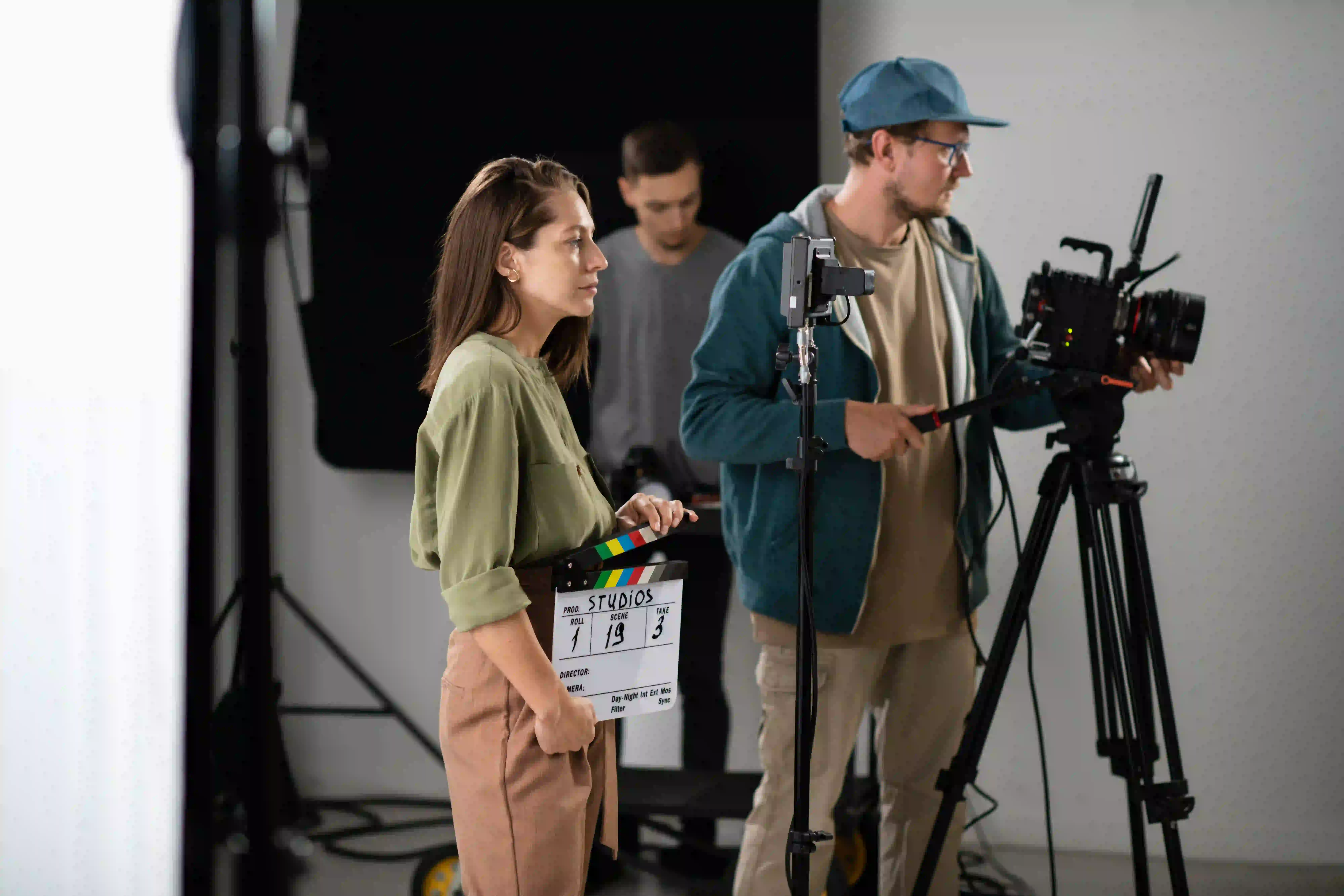
A corporate video checklist by All In Motion, global B2B creative production leaders for enterprise brands in Mumbai, Pune, Poland & Canada.


From Our Blog
—
From Our Blog
—
From Our Blog
—
From Our Blog
—
From Our Blog
—
From Our Blog
—
How to Choose a Video Production Company in India: A Corporate Buyer's Checklist

Share:

If you have ever sat through a vendor review after a video project went sideways, you already know the real story. The invoice was never the problem. The problem was the eleven internal hours spent chasing revisions, the legal team flagging an unlicensed music track two days before launch, and the stakeholder in Singapore asking why the Hindi subtitles didn't match the voiceover. All of it shows up in the relationship with the agency, and in how much your team trusts the next project to go smoothly.
Corporate buyers evaluating a video production company in India are rarely comparing quality alone. Most mid-to-large agencies in this market can shoot clean footage and cut a competent edit. What separates a dependable long-term partner from a one-off vendor is process discipline: how they scope work, how they handle a note from an eight-person stakeholder committee, and how they behave when a deliverable needs to exist in four languages by Friday.
This checklist is written for the person who owns that decision; a marketing director, brand manager, or procurement lead running an RFP or shortlisting agencies for the first time. It reflects how enterprise buyers actually evaluate video partners at scale, drawn from working with global technology, professional services, and industrial brands where a single production runs across multiple markets and compliance layers.
Why the Wrong Hire Costs More Than the Invoice
A low quote is easy to justify on a purchase order. It is much harder to justify after the third round of "just one more revision," a missed trade-show deadline, or a rebrand that requires re-cutting eighteen videos because the original agency never delivered organized source files.
The real cost of a mismatched video partner shows up in four places:
1. Internal time. Every unclear brief, every unstructured revision round, and every miscommunication get absorbed by your team, not the agency's. A project quoted at three weeks that takes nine consumes far more of your bandwidth than the fee difference between vendors ever would.
2. Opportunity cost. A campaign video that misses its launch window because of a production delay doesn't just cost the production budget; it costs the media spend, the event tie-in, or the sales enablement moment it was built for.
3. Compliance and brand risk. Enterprise brands operate under legal review, brand guidelines, and often data or industry-specific compliance requirements. An agency unfamiliar with enterprise governance can introduce risk that a small-business client would never encounter; unlicensed stock assets, off-brand messaging, or non-compliant claims in a regulated industry.
4. Asset reusability. Video that can't be repurposed across markets, languages, or formats because the agency didn't retain organized project files, raw footage, or editable source assets forces you to reshoot rather than adapt, doubling the cost of every future update.
None of this shows up in a rate card. It shows up six weeks into the engagement. That's why the vetting process matters more than the pitch deck.
Section 1: The 6 Capability Checks Enterprise Buyers Should Run Before an RFP
Before you send out a formal RFP, run these six checks. They take a few hours and will eliminate agencies that look strong on a website but cannot execute at enterprise scale.
1. Crew depth, not just crew existence
Ask directly: is the crew for your project in-house, or assembled per project from a freelance network? Neither answer is automatically disqualifying, but you need to know which one you're getting, because it changes how you should manage the engagement.
A production house running entirely on freelance crews can still deliver excellent work, but you should expect more variability between projects and less institutional memory of your brand from one shoot to the next. An agency with a core in-house production and post-production team, even if they supplement with specialists for niche formats like drone cinematography or 3D animation; gives you more consistency across a multi-video engagement.
What to ask: "Who on this list is a full-time employee, and who is a freelance collaborator you've worked with before?" A confident agency will answer this without hesitation.
2. Post-production bench strength
Filming is the visible 20% of a video project. Editing, colour grading, sound design, motion graphics, and revisions are the other 80%, and it's where most timeline slippage actually happens. Ask to see:
• A sample project timeline showing how many revision rounds were built in versus how many actually occurred
• Whether colour grading and sound mixing are handled in-house or outsourced
• Turnaround time for a standard 2–3 minute corporate video from final footage to first cut
If an agency can't produce a realistic post-production timeline on request, that's a preview of how the actual project will run.
3. Motion design and animation capability

Most enterprise brands eventually need more than live-action footage, data visualizations for a product explainer, animated lower-thirds for a leadership message, or a fully animated explainer video for a technical concept that's hard to film. Ask to see motion and animation work as a distinct portfolio category, not folded into "video work" generally. Live-action and motion design are genuinely different skill sets, and an agency strong in one is not automatically strong in the other.
4. Multi-language and localization workflow
If your organization operates across markets, which most enterprise buyers do; this is one of the highest-risk gaps in a video partner's capability. Localization is not just dubbing or subtitling. Ask specifically:
• Do they manage translation and transcreation, or only technical subtitling?
• How do they handle lip-sync adjustments for dubbed voiceover versus subtitle-only localization?
• Can they maintain consistent brand terminology across languages using a glossary or style guide?
• Have they delivered a single video in five or more language versions before, and can they show it?
An agency that treats localization as an afterthought will hand you a translated transcript and call it done. An agency built for global brands treats it as its own production discipline.
5. Project management infrastructure
At enterprise scale, the deliverable isn't just the video, it's the process that gets you to the video without twenty email threads. Ask how they manage:
• Stakeholder feedback consolidation (does one person on their side own collecting and reconciling notes from your multiple reviewers?)
• Version control and asset naming conventions
• Status visibility; do you get a live project tracker, or do you have to ask for updates?
This single capability checks filters out more mismatched agencies than any portfolio review, because it's the difference between a vendor and an operating partner.
6. Global delivery model and time-zone coverage

An analog clock hanging from a ceiling, representing global delivery models and timezone coverage for corporate video production.
If your organization runs marketing operations out of North America, Europe while sourcing production out of India for cost and talent advantages, confirm the agency actually operates as a global delivery team, not a single office trying to stretch across time zones informally. Ask where their production and account management teams are physically based, how they structure handoffs across time zones, and who your single point of contact is when a deliverable needs sign-off outside standard IST hours. A production partner with a genuinely distributed footprint; production hubs in India alongside account or creative leadership closer to your market will have a concrete answer. A partner improvising this for the first time usually won't.
Section 2: Red Flags in Pitches and Portfolios That Predict Scope Creep
Scope creep rarely starts as a dramatic failure. It starts small, in the pitch, and compounds through the engagement. Watch for these patterns before you sign anything.
The portfolio has no context
A reel full of polished thumbnails tells you an agency can produce something that looks good in isolation. It does not tell you whether that work achieved its business goal, what the brief was, or how many revisions cycles it took to get there. Ask for one or two case studies with real context: original objective, constraints, timeline, and outcome. An agency that can only show finished output with no process narrative, likely doesn't track its own process either.
Every question gets a "yes" with no follow-up questions
A pitch where every capability question gets an enthusiastic "yes, absolutely" without a single clarifying question is a warning sign, not a reassurance. Enterprise video projects have real constraints; brand guidelines, legal review cycles, stakeholder committees, existing style guides. An agency that doesn't ask about any of these in the pitch stage either hasn't worked at this scale before, or isn't planning to account for it in the estimate. Either way, you'll discover the gap mid-project, when it's expensive to fix.
Vague or bundled pricing with no line items
If a proposal quotes a single lump-sum number with no breakdown of pre-production, production days, post-production hours, and revision rounds included, you have no way to know what happens when scope shifts and it will shift. Ask for a scope document that specifies exactly how many revision rounds are included per deliverable, and what the process and cost is for revisions beyond that. This single document prevents the majority of billing disputes later in the relationship.
No clear ownership of feedback consolidation
Ask directly, "If five people on our side give conflicting feedback, what happens?" A mature agency will describe a process; a single point of contact who consolidates notes, flags conflicts back to you, and confirms sign-off before proceeding. An agency without an answer to this question will let every stakeholder's feedback hit the editor directly, and your timeline will absorb the chaos.
Reluctance to discuss past project timelines honestly
Ask how many of their last ten projects delivered on the originally quoted timeline. A confident, experienced agency will give you a real number and explain what caused the exceptions. An agency that deflects with "it depends on the client" every time is telling you, indirectly, that timeline management isn't something they track or take responsibility for.
No mention of source file and asset ownership
Before signing, confirm in writing that you retain ownership of raw footage, editable project files, licensed music and stock assets, and final masters at project close, not just the exported final video. Agencies that are vague about this on request are often the ones who make repurposing your own content unnecessarily difficult, or impossible, later.
Section 3: How to Structure a Pilot Project Before a Full Retainer
The single most effective way to de-risk a new video partnership is to run a paid pilot before committing to a retainer or a multi-video annual scope. This isn't about distrust, it's standard enterprise procurement practice for any vendor relationship with recurring spend, and any experienced production partner will expect it.
Choose a real, representative project, not a test. Pick an actual deliverable you need, ideally mid-complexity: a single corporate video or one explainer video rather than your flagship brand film or your simplest social clip. You want a project complex enough to reveal how the agency handles revisions, stakeholder input, and timeline pressure, but contained enough that a misstep doesn't derail a major launch.
Define the evaluation criteria before the project starts, not after. Decide in advance what "successful pilot" looks like: On-time delivery against the agreed schedule. Revision rounds used versus revision rounds included. Responsiveness to feedback measured in turnaround time, not just tone. Quality of the consolidated communication (did one person manage your feedback loop, or did it feel disorganized). Write these down and share them with the agency; transparency here gets you a fairer test, not a weaker one.
Keep the commercial terms proportionate. A pilot should be priced and scoped as a standalone engagement, not a discounted loss-leader that either side treats casually. If an agency is willing to work at a steep discount to "win the relationship," ask what changes once the discount ends; sometimes nothing, but it's worth confirming before you scale spend.
Involve the actual stakeholders who will be in the loop long-term. If your CMO or a regional marketing lead will be reviewing every deliverable once you're at retainer scale, include them in the pilot's feedback rounds. A pilot reviewed only by the procurement team tells you less about how the day-to-day working relationship will actually feel.
Debrief formally before scaling up. After delivery, run a structured retrospective with the agency: what worked, what friction points came up, what would change at higher volume. An agency that engages seriously with this conversation rather than treating it as a formality; is signalling how they'll handle feedback once real stakes are involved.
A well-structured pilot typically takes four to eight weeks depending on video complexity, and it is worth every day of that timeline. It is far cheaper to discover a mismatch on a single video than three videos into an annual retainer.
Choosing a Partner Built for Enterprise Complexity
India has become one of the world's most active hubs for B2B video production, combining strong technical talent with cost efficiency relative to markets like the US, UK, and Western Europe. That advantage is real but it only pays off when the agency you choose is actually built for enterprise complexity; multi-stakeholder review cycles, brand governance across markets, and production that needs to scale reliably rather than as a one-off win.
Buyers evaluating a video production company in India for ongoing, high-volume, or multi-market work should weigh capability and process discipline as heavily as creative quality, because at enterprise scale, process discipline is what determines whether creative quality shows up consistently, on time, project after project.
If you're currently running an RFP for a corporate video partner and want a structured way to compare agencies against this exact checklist, All In Motion works with enterprise brands including Capgemini, TCS, Wipro, Genpact, EY, and HCL; out of production hubs in Mumbai and Pune, alongside teams supporting clients across Poland and Canada, to deliver corporate video at exactly this level of governance and scale. Get in touch to talk through your next corporate video project.
Frequently Asked Questions