Accessibility shouldn't be a last-minute scramble before launch. This enterprise video accessibility checklist breaks down captions, subtitles, WCAG, and global compliance—giving your team a clear pre- and post-production workflow to build accessible video from the first brief.


From Our Blog
—
From Our Blog
—
From Our Blog
—
From Our Blog
—
From Our Blog
—
From Our Blog
—
The Enterprise Video Accessibility Checklist: Captions, Subtitles and Global Compliance

Share:
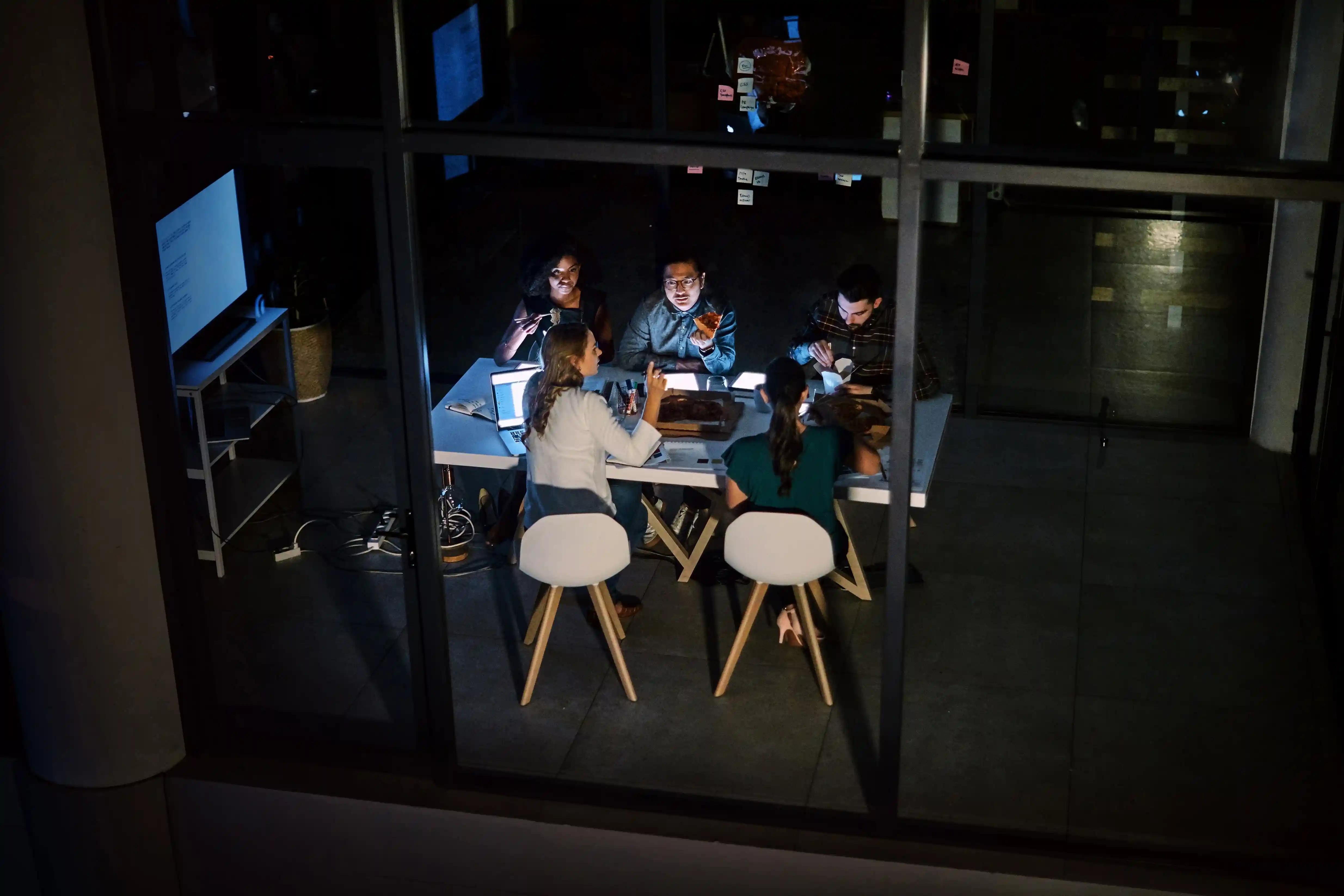
Accessibility on video usually gets thought about at the worst possible moment, which is after the film is done. By then the captions have to squeeze into a design that never planned for them. If you've ever had a client ask "does this have captions?" the day before launch, you know the feeling.
Fixing it at that stage costs more time and more money than planning for it would have. A good video accessibility checklist moves those decisions to the start, when they're cheap and much easier to incorporate. Below you'll find what each term means, what the rules roughly ask of you, who should own the work, and the checklist we'd recommend running before and after a shoot.
CAPTIONS, SUBTITLES, TRANSCRIPTS AND AUDIO DESCRIPTION
Captions, subtitles, transcripts and audio description are four different things, though briefs often treat them as one.
Captions put the audio into text in the same language. They include who is speaking and the sounds that carry meaning, like a phone buzzing in a scene. They're essential for viewers who are deaf or hard of hearing. It’s also widely used by commuters on public transportation, who are watching a video without headphones.
Subtitles translate the dialogue for people who can hear it but don't speak the language. Most leave the sound cues out. SDH, which stands for subtitles for the deaf and hard of hearing, is the version that puts them back in.
A transcript is the written version of what's said in the video. A descriptive transcript goes further and describes what's shown on screen. Screen reader users and braille display users depend on transcripts.
Audio description is a spoken track that describes important visuals for people who can't see them, like a chart appearing or an action happening on screen. It fits into the gaps between dialogue. The easiest way to keep it small is to write the voiceover so it says what the viewer needs to know. "As you can see here" tells a blind viewer nothing. "Sales doubled in March" tells them everything.
Translation, subtitles and accessibility also get mixed up. They overlap, but they're separate jobs. Ordering "subtitles in eight languages" covers translation. It doesn't help a blind viewer, and a deaf viewer will miss any sound cues the subtitles leave out.
WHAT THE RULES ASK, IN PLAIN TERMS

This isn't legal advice, and the details differ by country, so you should confirm what applies to you.
In the US, the Americans with Disabilities Act is the main reference. It requires businesses that serve the public to be accessible to people with disabilities, and the Department of Justice and many courts say that includes their websites. No rule spells out the technical requirements for private company sites, so courts commonly use WCAG as the yardstick. If you sell to federal agencies, accessibility requirements show up in your contract.
In Europe, there’s an actual rulebook. The European Accessibility Act has applied since June 2025 to consumer-facing services such as online shops and banking. Services sold only to other businesses are generally outside it, and so are very small companies. Public sector websites follow a separate directive. Each EU country has written these rules into its own national law.
Most of these rules lean on one document, the Web Content Accessibility Guidelines, or WCAG. It’s the international standard for making digital content accessible to people with disabilities, video included. Treat it as your baseline and you’ll be aiming at the right thing in both places.
ONE LAUNCH FILM, FOUR PLACES IT PLAYS
Say a software company makes a two-minute launch film. Watch how the same file picks up different obligations as it travels.
On the public website, captions are the baseline, and a written transcript underneath helps. If the film shows important things the voiceover never mentions, add audio description too. And if customers in Europe can buy something from that page, European accessibility law is likely to apply to it, video included.
On LinkedIn, the law rarely comes into it. The practical case is enough: plenty of people scroll with the sound off. Upload caption files where the platform lets you. Those are closed captions, which viewers can switch on and off and which can be translated. Burned-in captions, where the text is part of the picture, can't be changed or turned off.
On the internal town hall page, employees are covered by workplace accommodation rules in both regions. Someone on the team is deaf, and someone else works in a third language. Captions serve both.
At the trade show booth, the screen loops in a noisy hall. Open captions suit it, since there's no remote or settings menu to switch anything on.
Same film, four different answers. One master file must support all of them.
LIVE VIDEO PLAYS BY DIFFERENT RULES
Webinars, town halls and hybrid events can't wait for an edit. Live captions come from either a human captioner or an automated tool. A human captioner costs more but handles jargon better. Whichever you choose, send the captioner the speaker list and a glossary a day ahead. If a sign language interpreter is booked, plan the camera framing so they stay in shot.
Then later, deal with the recording. Live captions usually contain errors, so don't reuse them in the replay. Swap in a corrected caption file before the recorded version goes out.
WHO OWNS THIS?
Ask who's responsible for accessibility on a video project and you'll often hear a lot of "I thought you had it." Everyone assumes someone else is covering it. Pick one person. We suggest whoever owns the brief, because that's where requirements enter the project. It's also worth asking vendors which caption standard they work to before you hire them, as quality varies a lot.
WHERE ACCESSIBILITY MEETS BRAND DESIGN

Designers sometimes hear "accessibility" and picture ugly captions in default white. Fair worry that has a simple fix; design for it early.
Leave a caption-safe zone at the bottom of the frame and keep lower thirds out of it. Test your caption style on a phone, since that's where most people will watch. Animated onscreen text looks great, but a screen reader can't read it, so the voiceover or a transcript has to carry the message.
Done early, captions look like part of the film. Done late, they look like add-on sticker.
AUTO-CAPTIONS ARE A FIRST DRAFT
AI captioning has made the baseline cheaper and faster, which is good news. Auto-captions still stumble on product names, acronyms, accents and anyone speaking over music. A caption that turns "cloud native" into "clown native" is funny until it lands in front of a client or a few hundred employees. For a deaf or hard of hearing viewer, the caption is the whole message, so a wrong one changes what they think was said.
Build a human review into the schedule and give the reviewer your glossary. Do the same for AI subtitles and dubbing in other languages.
The Video Accessibility Checklist
Use it before the shoot and again after the edit.
Before production
- Brief: Specify which accessibility outputs you need, the languages, and every platform the film will appear on.
- Script: Check that the voiceover carries the key information. Anything that only appears on screen, like a stat or a chart, should also be said or described.
- Design: Leave space at the bottom of the frame for captions, check that on-screen text stays readable against the footage.
- Motion: Keep flashing effects under three flashes per second. More than that can trigger seizures in people with photosensitive epilepsy.
- Language: Make a short glossary of names, product terms and how to say them. Translated text is often longer than the English, so leave room for it in the layout.
- Vendors: Book captioning, translation and any audio description work into the schedule, with time to review.
After production
- Captions: Have a human review every file against the final cut. Check timing, accuracy, speaker labels and meaningful sound cues. Keep to two lines and break at natural phrases.
- Audio description: If the video shows important things the voiceover doesn't mention, add a spoken description of them.
- Transcript: Publish a written version next to the video.
- Player: Test with a keyboard and a screen reader. Make sure captions can be switched on.
- Viewing: Watch the final cut on mute, then on a phone. A lot of your audience will watch this way, and it's where cramped or badly placed captions show up.
- Version control: Re-time the caption files after any change to the edit. Trim one shot and every caption after it drifts out of sync. So, keep that in mind.
KEEPING IT ALL STRAIGHT ACROSS MARKETS
Once the film travels, the files multiply, and the video accessibility checklist has to travel with it.
Start with a textless master, with on-screen text on separate layers, so localized versions don't need a re-edit. Store caption and subtitle files as their own assets and name them after the exact video version they belong to. The most common failure we see is a v3 caption file used on a v4 film, every line drifting a second late.
Keep one tracker with the version changes, languages, status of each accessibility output, and a named owner.
Choose one standard for every market and apply it to every film.
HOW WE BUILD IT IN AT ALL IN MOTION
At All in Motion, accessibility goes into the creative brief from the first conversation, next to the audience and the message. We ask who will watch, on what screen, and whether the sound will be on.
Scripts get checked for anything that only appears on screen, and storyboards leave room for captions. The edit gets watched on mute, and caption files are checked before delivery.
If you're planning a video and want accessibility built in from the first brief, talk to us. We'll make it part of the plan, so it never turns into a last-minute scramble.