Project:
eGovernment Benchmark 2024 Animation Series
Platform:
Short-Form 3D Animations for LinkedIn
Client:
Capgemini
Turning the eGovernment Benchmark 2024 into a LinkedIn series that reached over 640,000 people without losing a single insight.


Turning the eGovernment Benchmark 2024 into a LinkedIn series that reached over 640,000 people without losing a single insight.

This engagement was delivered through our CORE™ framework - Consultative, Optimized, Reliable, Enterprise-Grade.
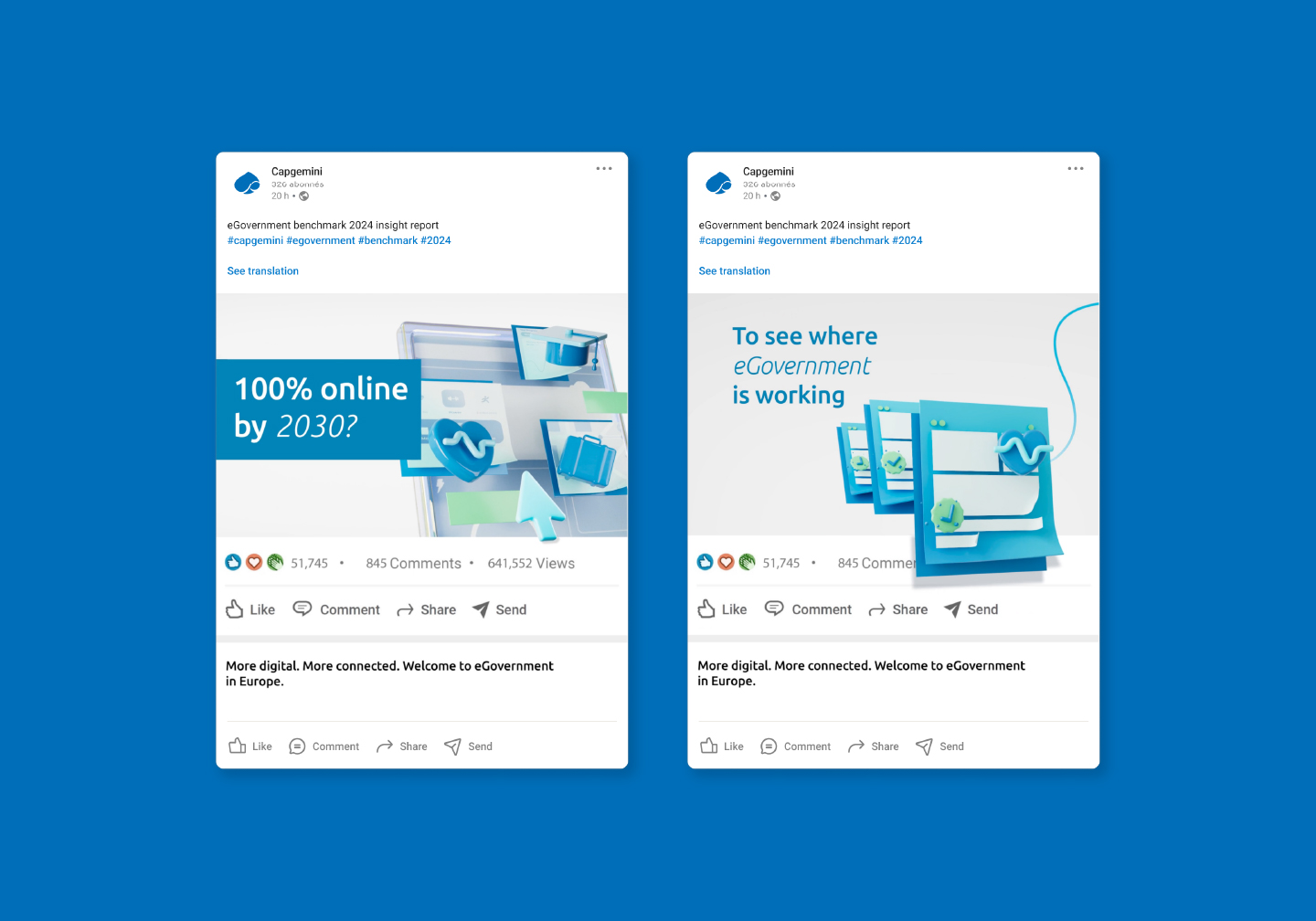
Capgemini’s eGovernment Benchmark 2024 is one of the most comprehensive assessments of digital public services in Europe, evaluating over 14,000 websites across 37 countries, measuring how effectively governments are delivering services to citizens online.
Our strategic consultation quickly highlighted the strength of the report’s findings, with 91% of central government services available online, 88% of portals offering live support, and 29% already featuring AI chatbots. We saw an opportunity to further amplify its impact by refining how these insights were presented and shared with the public sector decision-makers best positioned to act on them.
The brief was therefore not simply to animate the report. It was to engineer a distribution strategy that could take institutional findings and make them land with a LinkedIn audience that scrolls fast, stops rarely, and responds only to content that establishes immediate relevance.
Two additional constraints shaped the scope: each animation needed to tease rather than tell, building enough tension to drive audiences to the full report without giving everything away, and brand guidelines were actively evolving during production, requiring a visual system flexible enough to absorb those changes without breaking consistency across the series.
Complex information doesn’t need more explanation. It needs better structure.
The report’s data was already compelling. The strategic job was to give it a shape that social audiences could follow and a destination worth arriving at. We built the series around a single repeatable architecture: open with a question that creates immediate organisational tension, build through layered data, resolve with the report as the destination.
The visual system was designed around stylised 3D iconography, classical pillars for governance, chat bubbles for AI support, Euro coins for economic life events, functioning not as decoration but as a translation layer between abstract institutional data and immediate audience comprehension. The system was architected from the outset for flexibility, ensuring that evolving brand guidelines could be absorbed mid-production without requiring a structural rebuild.

Each animation was built around one of three distinct narrative structures drawn directly from the report’s findings:
Framed digital government as a momentum story — 91% of central government services online, with 2030 as the strategic horizon.
Established scale and institutional ambition — 14,000 websites assessed across 37 countries, a continent-wide evaluation of digital public service delivery.
Addressed the question most directly relevant to a public sector audience navigating AI adoption and answered it with verified data.
Every execution followed the same proven architecture: hook, data build, report reveal. The 3D visual language carried the evidential argument between those beats, stylised iconography translating statistics into recognisable real-world contexts, floating geometry creating motion and energy without distracting from the data. The report reveal was engineered as a design moment in its own right, giving each animation a clear destination and the audience a clear reason to act.
641,552 views. 845 comments. One benchmark report that finally reached the audience it deserved.
The series generated over 641,000 views on LinkedIn, with 51,745 reactions and 845 comments, performance metrics that represent a fundamental reframe of what a public sector research report can achieve through social distribution.
For Capgemini, the strategic outcome extended beyond reach. The eGovernment Benchmark 2024 was repositioned as a landmark piece of thinking on digital public services in Europe, not just a research document, but a public conversation. The engagement demonstrated a measurable capability: translating institutional complexity into social content that performs at scale, without sacrificing the evidential rigour that gives the underlying research its authority.